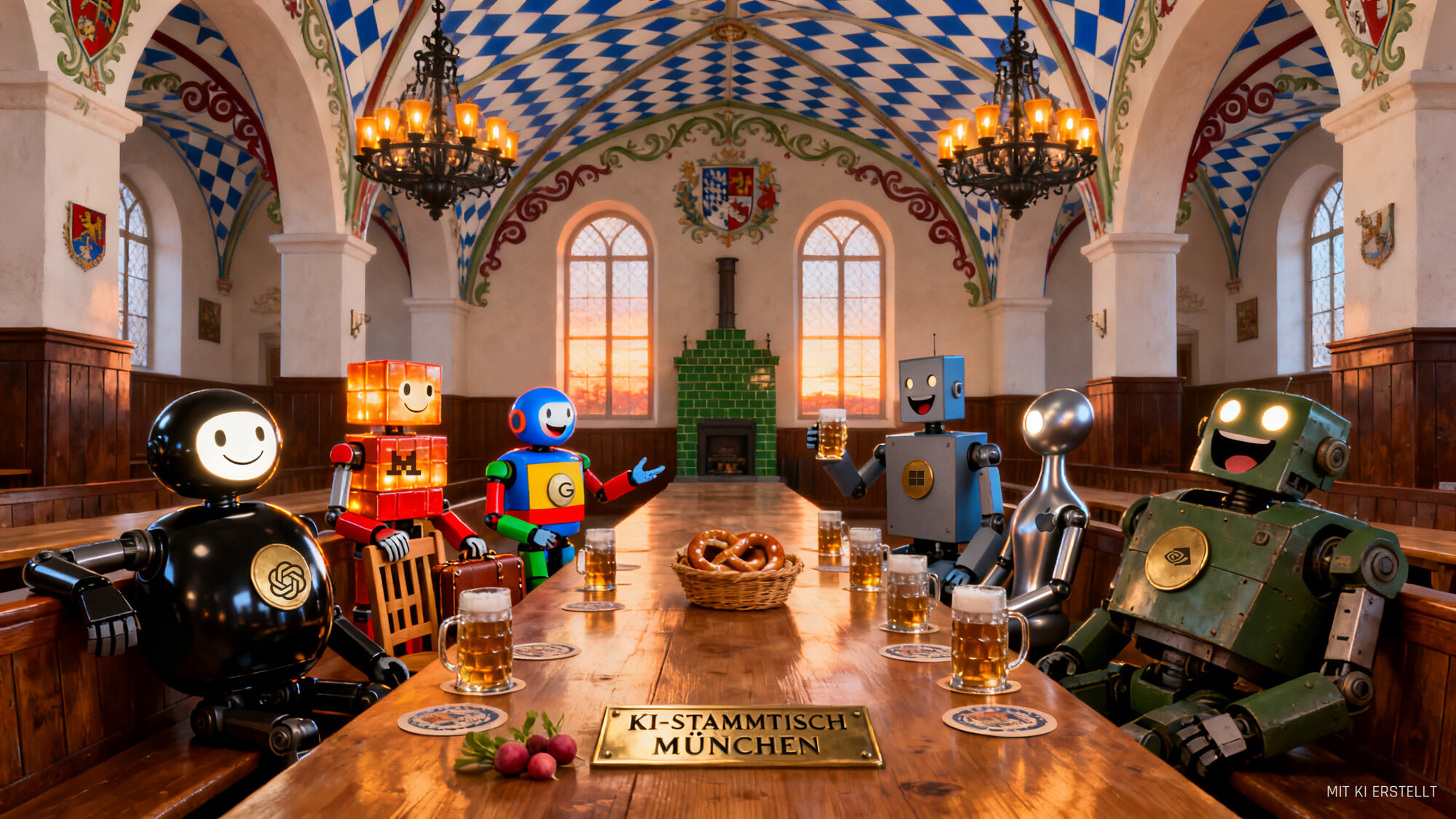
- Three model providers in one city: OpenAI opened its first German office here, Anthropic picked Munich alongside Paris, and Mistral is now opening an office.
- Compute has arrived: the Industrial AI Cloud in Tucherpark, roughly 10,000 NVIDIA Blackwell GPUs, up to 0.5 exaFLOPS — more than a third committed at launch.
- The bottleneck has moved: no longer "do we have access to AI" but "how do we get AI into our processes". That is exactly where proximity to customers becomes a location advantage.
- The thesis: Munich will not become Europe's AI capital. It could become Europe's deployment capital. That is the smaller claim — and the more interesting one.
OpenAI. Anthropic. Mistral. Microsoft. Google. Apple. NVIDIA. They all have Munich on the map. Is the city really on its way to becoming Europe's AI capital? Maybe. But for a different reason than you might first assume.
Last week the Munich AI table gained another guest. Mistral AI is opening an office in Munich. Bavaria's digital minister Fabian Mehring did not need much prompting: "Bavaria will become Europe's AI centre."
You can file that under location marketing. Or you can look a little closer.
The table is filling up #
Because Mistral is not coming alone. OpenAI opened its first German office in Munich. Anthropic selected Munich alongside Paris for its further European expansion. Microsoft, Google and Apple have been here for years. And with Mistral, one of Europe's most important providers of foundation models now joins them.
So the interesting question is not: Is Munich Europe's AI capital? It is: why does everyone suddenly want a seat at this table?
Paris builds models. London has capital. Berlin has startups. Munich has industry. #
Of course that sentence is a simplification. But a rather interesting one.
If you judge Europe's AI landscape purely by where the largest models are built, Munich is not your first stop. Mistral comes from Paris. London has an enormous technology, research and financing ecosystem. Berlin has Germany's largest startup scene.
Munich plays a different game. Here, AI and deep tech meet one of Europe's strongest industrial regions: BMW, Siemens, Allianz, Munich Re, Infineon, MAN/Traton, MTU, Rohde & Schwarz — plus countless mid-sized companies, suppliers and hidden champions across Bavaria and southern Germany.
For an AI provider, that is rather attractive. Because the next phase of the AI boom will not be decided solely by who trains the most capable model. It will also be decided by who gets AI into real business processes.
The model providers arrive #
OpenAI opened its first German office here. The company's reasoning is notable: it points explicitly to Germany's technical excellence, industrial innovation and strong demand for its technology.
More interesting than the office, though, is what was built beside it: OpenAI runs an AI workshop for the Mittelstand in Munich. Not a showroom, not a sales floor — a place where companies without an AI department work through their actual cases.
You do not open a workshop for customers who already know what they want to build. You open it where demand is real but implementation capability is still missing. That is the strongest available evidence for the deployment thesis — and it does not come from me, it comes from OpenAI.
Anthropic followed with Munich and Paris as further European locations. And now Mistral. That Europe's challenger to OpenAI and Anthropic picks Munich as its DACH location fits the pattern. This is more than collecting logos: these companies are positioning themselves where their next large customers sit.
Who or what is Mistral, exactly? #
If you do not work with models daily, you might initially file Mistral as yet another AI software vendor. In fact Mistral AI is one of the most strategically interesting technology companies in Europe.
The company was founded in Paris in 2023 by Arthur Mensch, Guillaume Lample and Timothée Lacroix. The founders came from the AI teams at Google DeepMind and Meta — with an ambitious goal: Europe should not become entirely dependent on American model providers for generative AI.
Mistral therefore builds its own large language models and competes, technologically at least, in the same category as OpenAI, Anthropic and Google DeepMind. Its approach differs in part: alongside commercial models and APIs, Mistral also releases models with open weights. At the same time it positions strongly with organisations that demand more control over deployment, data and infrastructure.
That is precisely what makes Mistral interesting for the European market. A company does not necessarily have to consume AI as a cloud service from an American hyperscaler. Depending on the model and architecture, more tightly controlled or self-hosted deployments are possible.
In an era of the EU AI Act, data protection, digital sovereignty and debate about Europe's technological dependence, that is far more than a technical detail. Mistral is also a piece of European industrial policy. And by now a rather valuable one.
The company raised three billion euros in September 2026 and has since been valued at more than 21 billion euros, putting it among Europe's most valuable private technology companies.
What is interesting is where the money comes from — and where it does not. That round was led by Samsung, with participation from the EU-backed Scaleup Europe Fund. The round before it, 1.7 billion euros at an 11.7 billion valuation, was led by ASML — the Dutch company whose lithography systems are effectively indispensable for manufacturing advanced semiconductors. ASML remains the largest shareholder.
That creates a notable European chain: ASML → chips. Mistral → models. Munich → industry.
The fresh capital for Europe's AI champion now comes from South Korea. Sovereignty, it turns out, is easier to demand than to finance. And none of this is yet a European alternative to the full American AI stack — NVIDIA, Microsoft, Google and AWS remain central to Europe's AI infrastructure too.
But it shows where things could go. And that is why the decision for Munich is more interesting than the opening of another sales office. Mistral finds here almost exactly the customers its positioning should appeal to: industrial companies, insurers, financial services, healthcare, defence, public institutions and a large Mittelstand — organisations for which control, data sovereignty and integration into existing systems can matter at least as much as the last point on a benchmark.
Munich suddenly gets serious compute #
An AI ecosystem needs more than smart offices and enterprise sales, though. It needs compute. And here too, something interesting happened in 2026.
In Munich's Tucherpark, Deutsche Telekom has brought its Industrial AI Cloud online together with NVIDIA and partners. The facility runs in a Polarise data centre, operational since late April 2026.
| Metric | Value | What it means |
|---|---|---|
| GPUs | ~10,000 NVIDIA Blackwell | Hyperscaler-grade training and inference capacity, in Germany |
| Compute | up to 0.5 exaFLOPS | Enough for production industrial workloads, not just pilots |
| Utilisation | > one third at launch | Demand existed before the infrastructure did |
That changes the quality of the location. From "interesting companies are based here" to "infrastructure is being built here that companies can actually run AI on".
For German industrial companies in particular, data protection, data sovereignty and regulatory requirements come on top. Which gives the term "industrial AI" a rather concrete meaning.
Then there is the TUM machine #
One factor is easily underestimated: universities do not only produce research. They produce founders, talent and companies. And in the Technical University of Munich, the city has a remarkably effective flywheel.
Dealroom counts hundreds of university-linked foundations and well over a thousand alumni-founded companies in Munich's academic ecosystem, plus scale-ups and unicorns such as Celonis and Helsing.
That matters for AI. An OpenAI or Mistral office needs developers. A deep-tech startup needs researchers. A Siemens needs AI engineers. An investor needs founders. They all draw on the same talent pool.
That is how clusters form. Not through a single company, but because each new company makes the location slightly more attractive for the next one.
On the startup ecosystem itself, Berlin remains larger and broader. But Munich is developing particular strength in deep tech, defence tech and research-adjacent technology — Helsing, Quantum Systems, Agile Robots and Celonis fit the pattern exactly. Munich is evidently not trying to copy Berlin.
And then industry sits right next door #
This, for me, is the decisive difference.
Foundation models are becoming increasingly interchangeable. Companies can choose today between OpenAI, Anthropic, Google, Mistral and open-source models. The bottleneck is shifting.
No longer: do we have access to AI?
But: how do we get AI into our processes, machines, products and organisations?
And suddenly a location full of companies with real production plants, supply chains, insurance processes, vehicle development, robotics, engineering and complex enterprise systems becomes rather interesting. Because that is where the use cases are.
Maybe "AI capital" is the wrong category #
Paris has Mistral. London has capital, research and a huge international tech market. Berlin has an exceptionally broad startup scene. Munich does not need to beat any of them.
Perhaps something more specific is emerging. Not necessarily Europe's AI capital. But Europe's industrial AI capital. Or, more interesting still: Europe's AI deployment capital.
Because between an impressive foundation model and measurable productivity inside a company lies an enormous distance. Data has to be available. Systems have to be connected. AI agents need permissions. Models have to be evaluated. Security and compliance have to work. Employees actually have to use it. And at some point a pilot has to become a production process.
That is exactly where the economic value of AI is decided.
My position #
OpenAI is already seated. Anthropic is pulling up a chair. Mistral says bonjour. Microsoft, Google and Apple have known the place for years. NVIDIA supplies the kitchen, more or less. And at the next table sit BMW, Siemens, Allianz, Munich Re, Infineon and a long line of German Mittelstand companies.
None of that proves Munich is Europe's AI capital. But it is a rather good argument for looking more closely.
London finances it. Paris builds it. Berlin starts it. Munich industrializes it. — Operator note
Because Europe's AI competition may not produce a single capital at all. Perhaps a division of labour is emerging instead. And if that holds, Mistral's new Munich office is not the real story. It is just the next free chair taken at the Munich AI table.
If the bottleneck is no longer the model but the deployment, then the right question in your next strategy meeting is not "which model do we pick" but: which of our processes is described clearly enough that an agent could take it over — and who decides where it has to stop?
The regulatory frame sits in the cornerstone: → EU AI Act · 2 August 2026 — what companies must do NOW.
The conclusion "Munich industrializes it" is an AMIA thesis, not an objective ranking. Figures and claims reflect the research state of 13 September 2026. A few data points — 20 petabytes of storage, Dealroom figures on TUM foundations, Anthropic's precise Munich footprint — could not be verified against primary sources and should be read as orders of magnitude.
FAQ
Is Munich now Europe's AI capital?
That is the wrong category. Paris has Mistral, Europe's model builder. London has capital and research depth. Berlin has the largest startup ecosystem. Munich's strength is the density of research, compute, big tech and industrial demand. The more accurate description is therefore not AI capital but deployment capital: the place where AI gets translated into real economic value. That is a thesis, not a ranking.
Which AI companies have a presence in Munich?
OpenAI opened its first German office here and also runs an AI workshop for the Mittelstand. Anthropic chose Munich alongside Paris for its European expansion. Mistral AI is opening an office. Microsoft, Google, Apple and NVIDIA have been on the ground for years.
What is the Industrial AI Cloud in Munich's Tucherpark?
A joint facility from Deutsche Telekom and NVIDIA with roughly 10,000 NVIDIA Blackwell GPUs and up to 0.5 exaFLOPS of compute, operated in a Polarise data centre since late April 2026. At launch, more than a third of the capacity was already committed to existing customers.
Who is Mistral AI and why does it matter?
Mistral AI was founded in Paris in 2023 by Arthur Mensch, Guillaume Lample and Timothée Lacroix, who came from the AI teams at Google DeepMind and Meta. The company builds its own large language models and, alongside commercial models, releases models with open weights. That makes more tightly controlled or self-hosted deployments possible — relevant for organisations with data sovereignty requirements.
How much is Mistral AI worth?
Mistral raised three billion euros in September 2026 and has been valued at more than 21 billion euros since. That round was led by Samsung, with participation from the EU-backed Scaleup Europe Fund. The previous round — 1.7 billion euros at an 11.7 billion valuation — was led by ASML, which remains the largest shareholder.
Why are AI providers choosing Munich over Berlin?
Berlin remains the larger and broader startup ecosystem. Munich offers something different: BMW, Siemens, Allianz, Munich Re, Infineon, MAN, MTU and a large industrial Mittelstand — the organisations where the use cases actually sit. Once the bottleneck stops being access to models and becomes integration into real processes, proximity to customers becomes a location advantage.